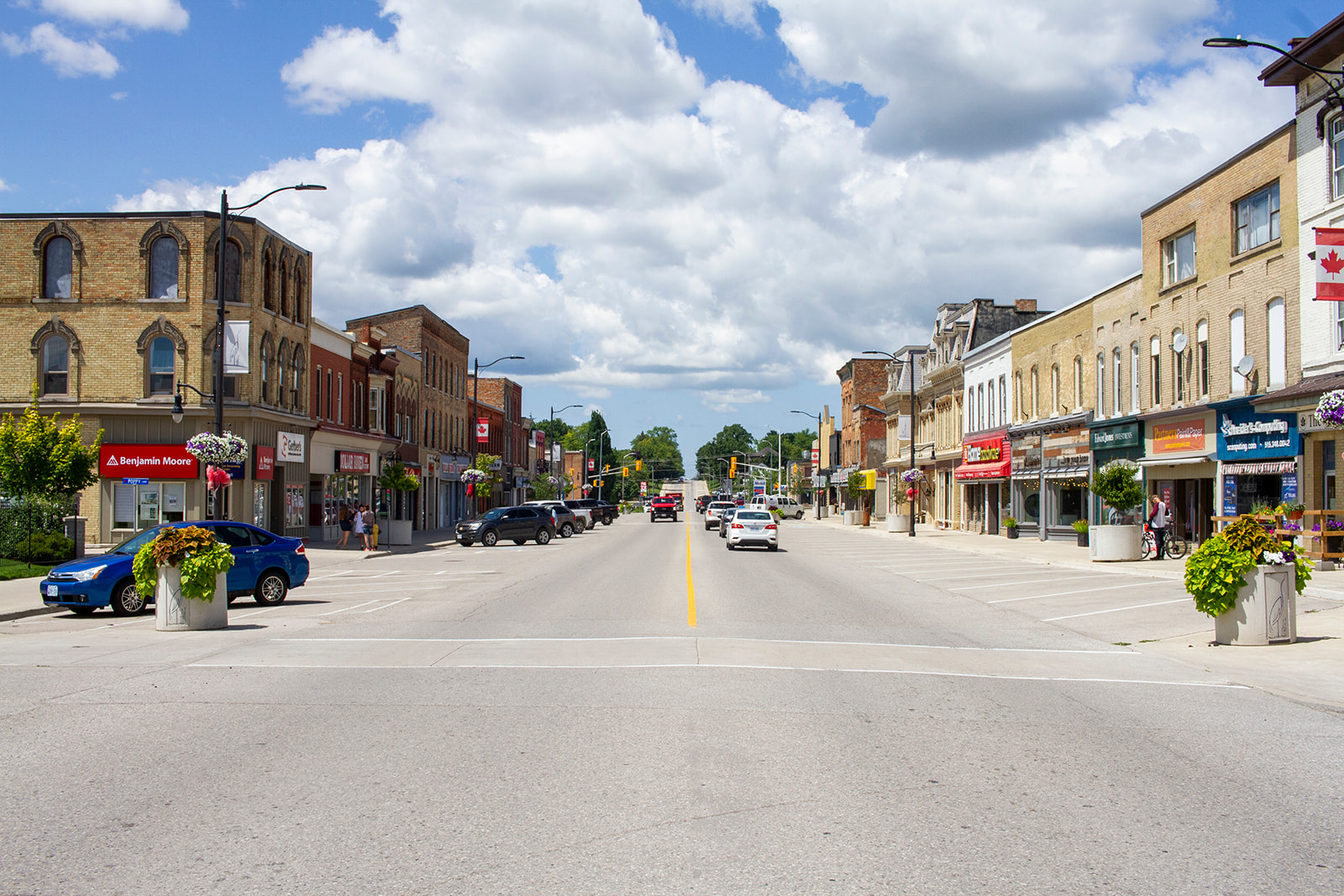
Ask anyone in Mitchell why they love this town and you’ll often hear the same phrase: the small-town charm. It’s real. You feel it driving down main street, walking past the old storefronts downtown, or sitting in the arena on a Saturday morning. But here’s the thing nobody says out loud: charm isn’t magic. It’s the accumulated result of thousands of small decisions — most of them made through bylaws most of us never read.
And right now, rapid development is threatening to wash a lot of that away.
What “charm” actually is, in concrete terms
Strip away the nostalgia and charm is physical. It’s tree-lined streets where a kid can ride a bike to a friend’s house under real shade. It’s houses that don’t all look identical — a mix of styles, setbacks, and front porches that says people live here, not units. It’s streets built at a walking scale, where neighbours actually cross paths. It’s a downtown that looks like a place with a history, because it is one.
None of that happens by accident, and none of it survives by accident either.
Decisions we make now, felt for decades
Here’s my favourite example, because it’s so simple: when a new subdivision goes in, require that every new lot gets a tree.
A tree costs almost nothing at planting. Twenty years from now, it’s a canopy that cools the whole street in August, shelters a kid’s lemonade stand, and makes a new neighbourhood feel like part of Mitchell instead of a place that could be anywhere in Ontario. Twenty years from now is exactly the horizon council should be thinking on — because the decisions we make this term are the streets my son will grow up walking.
The same logic applies to housing. A subdivision where every house is the same footprint, the same setback, the same garage-forward face? That’s a development that will look dated before the mortgages are paid off. A mix — singles, semis, some smaller homes, varied styles — builds a neighbourhood that can house a young family starting out, the couple downsizing, and the grandparents who want to stay in town while their grandkids grow up three streets over.
Pro-growth and pro-character are not opposites
I want to be clear, because this gets twisted: protecting Mitchell’s character is not code for “stop all development.” I’ve centred my campaign on responsible growth. Mitchell needs more homes, and young families like mine need places to live. But “more homes” and “homes that belong here” are not in conflict. We can grow — we should grow — and still insist that what gets built looks and feels like Mitchell.
That’s what a serious review of our development bylaws is for: sensible, concrete requirements — trees on new lots, breathing room between houses, a balanced mix of housing types, streets designed for people instead of just traffic — that keep the character we all love from being eroded one approval at a time.
The town we hand down
I grew up here. Abbey and I are raising our son here. When he’s old enough to walk these streets on his own, I want him to recognize the town I grew up in — not because we froze it in amber, but because we were deliberate about what we built and what we protected.
What makes Mitchell feel like Mitchell to you? Tell me. Your answer belongs in this conversation, and I’ll bring it to the council table.